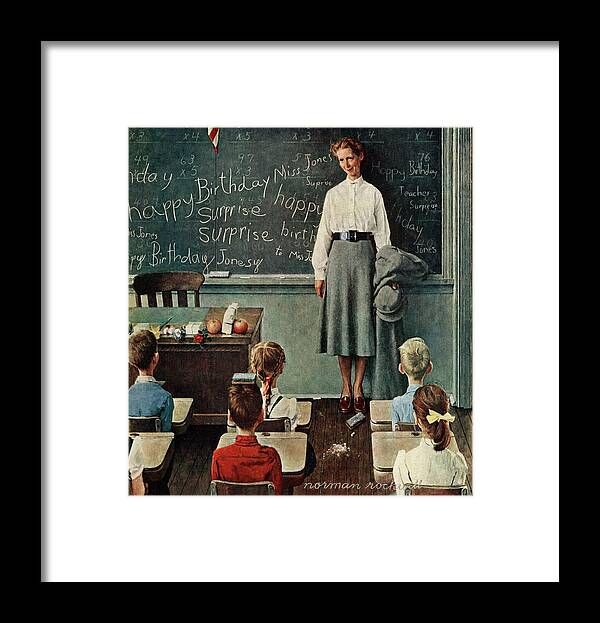

We all went to school, somewhere, at some time, for various periods of time. Among us there are high school graduates, and college graduates too many degree programs to mention—law, MD. PhD, etc. I was among the very lucky ones as I attended one of the premier high schools in the nation. That was just my good fortune and from K-12 I had some of the best teachers and courses anyone could hope to have. I was not a particularly gifted student, but I got by, probably graduating in maybe the upper third of my class, I’d guess 205 out of 624. I went to college at Western Illinois University. The choice was easy and pragmatic. Older brother David went there, and he said I would too and so I did. Brothers Douglas and Gregory would follow me in the birth order, so all four Taylor boys graduated from Western.
But it doesn’t matter how many years of education you have or what kind of degrees you earned or even where you went to school. What does matter is that somewhere along the line we all had special teachers who helped make us the people we’ve become today–teachers who challenged us, inspired us, pushed us a little harder than we’d liked, but teachers who were there at all levels preparing us for our own individual destinies. I’m told it’s weird that I can remember the names of most all my teachers from first grade on through graduate school. They taught me how to read and write, and to do algebra though poor Howard Stuebner had a tough time with Gordy Taylor and calculus. Brother David was the family math scholar. I learned about ancient civilizations and the founding of this great nation, and the civil war fought to sustain it. I took typing and speech and even learned how to say a few sentences in French. What I did not take, much to the everlasting chagrin of Diane and sons Gordon III and Ryan was “shop” and consequently I need help to change a light bulb and don’t know a hammer from a screwdriver. I’m quite helpless around the house and without my wonderful neighbor Greg Mason, I doubt our house would still be standing.
I guess this is me, simply reflecting on the value of education, and what it has done to and for each of us. For me, it all seemed to come together one magical quarter in college as an undergraduate. I took 18 hours, which was a full load plus a little extra. I’m a morning person which I suppose emanates from my youth when I was up at 5 a.m. to deliver the Chicago Tribune every morning for two interminably never-ending long years. But that’s a story for another time.
The following is an article I wrote and published in the Winter of 1998 edition of the Western News:
It happened during the Spring Quarter of 1966, my sophomore year at Western. I was doing fine scholastically and that reality would never change much, but my life as a student would. I guess you could call it the academic epiphany of Gordy Taylor. My schedule on Monday, Wednesday, and Friday was horrific. I was in class straight through from 8 a.m. to 1 p.m. It was a long time ago, but sometime during that quarter I realized that something very special was happening to me. It was no longer a matter of having to go to class, but rather I felt excitement, curiosity, and intellectual stimulation. It was an incredible time in my life, and as I reflect, I now understand what happened.
My 8 a.m. was Development of Civilization 134 with John Raatjes. Raatjes didn’t lecture out of a book about ancient societies; he took us there. One week the focus was on Africa and the explorations of the famous archeologist Louis Leakey. I entered class to the beat of African drums and natives speaking Swahili. It was a tape, but the entire class sat speechless as Raatjes took us with him to deepest Africa. It was electrifying. You could always tell wen Raatjes knew we were with him because his eyes twinkled with excitement. Even he was having fun.
My 9 a.m. was Earth Science 101 with Bob Gabler. He didn’t just tell us how the earth was formed. He took us on field trips around campus and showed us. When the subject was the solar system, he took us on an evening excursion to the old golf course where Higgins and Thompson Halls now stand and helped us make sense of the infinite sky above. Bob Gabler is not a timid man. Every minute of his class was loud, intense, and action packed. As he made a point, his arms moved so violently you thought he might take off like Peter Pan. Students just knew that Gabler loved to teach and he was fantastic.
My adrenaline was in full gear as I entered Garwood Hall at 10 a.m. where Jean Clow was teaching Principles of Accounting 281. It was like having a class with my mom. She explained that credits go by the window and debits by the wall. Her goal was to teach us the fundamentals and that she did, concluding the quarter with the infamous “practice set” whereby we had to balance the books for a fictitious enterprise. Mrs. Clow treated us like her own children which included a piercing stare and dressing down when needed. I will never forget the day Bill O’Toole, currently vice president of operations services at Walt Disney World, came to class with an incomplete assignment due to an important intramural football game the previous day. Clow looked at Bill and said, “Mr. O’Toole, you had an assignment due today, and you didn’t do it. That’s an F for today. Hope your team won.” Bill never made that mistake again.
Eleven a.m. took me to the second floor of Sherman Hall for Money and Banking 325 with Karl Marx. Honest, that’s how he spells his name. Marx had a habit of leaning against the window frame and on occasion would begin to fall out of the window to his certain demise. Then his remarkably quick hands would brace against the frame and propel his body back into the room. Every time it happened, my heart would skip a beat. At times, Marx seemed to be in a world of his own full of profound and deep thoughts, and we wanted to be there with him. One of my most vivid college memories is of this young professor, and the energy he expended as he explained the famous IS/LM curves. Marx would literally write on the blackboard with his right hand while erasing with his left hand. It was incredible, and after class we felt emotionally and intellectually drained.
Then it was noon, and I had one class to go: American History 225 with Victor Hicken. It would be one of the most extraordinary classroom experiences of my life. Victor Hicken WAS American History. It oozed from every pore of his body. We lived the American Civil War through the reflective eyes of this splendid educator. From Bull Run to Vicksburg to the burning of Atlanta he took us with him. You could cut the emotion in the classroom with a knife when he spoke of Lee’s surrender to Grant at Appomattox. You were there. Victor Hicken knew about war, knew about it firsthand, up close as only a veteran could. You see, a mere 22 years earlier, he had been part of the original assault force on Dog Green Sector, Omaha Beach, D-Day, June 6, 1944. Vic Hicken knew how to teach history.
The educational “spark” had been lit for me, and from that time on, I became a serious student. In my senior year it was time to contemplate what lay ahead so of course I asked brother David what I should do. It was 1968 and his response was quick and succinct, “Vietnam is exploding so you will go to graduate school” and I did. I got a NDEA Title IV Fellowship at the University of Florida, and the lovely Diane Paulsen married me on August 31, 1968. Two weeks later we began our life together in Gainesville, Florida, and of course we remain proud Gators to this day. I got my MBA and then finally the PhD with Diane working, taking classes herself, and encouraging me every time things got a little tough. The adventure continues to this day.
It needs to be mentioned that education is not something that exists only in the classroom though that is an important component of this dynamic. Sure, classroom teaching was helpful to us but there is also the great educational process that transpires outside the classroom in real life. We learn so much just by living, about the world, ourselves, and whatever it is that matters most to us. Somewhere along the line we learn how to communicate with others, how to interact with diverse personality types, how to map out our individual life destiny. The plan is never completed, particularly if we are lucky enough to make it to the 4th Quarter of our lives when health curve balls present a totally new reality and path to the future. There is a practical “life education” that enables us to pivot when adversity strikes and make changes that assist us in facing the “new reality” that inevitably will come our way. We lose our parents and that is the natural order of things, but the everyday lives of our children and their kids impacts on us, as does the health of our life partner. I know Diane and I could never have prepared ourselves for the health challenges that have come our way but that outside the classroom “education” has served us well as we face the realities of our lives today.
There you have it. Regardless of how any of us got to where we are today, we are all citizens of the world making our way as best we can. Hats off to Raatjes, Clow, Marx, Gabler, and Hicken for lighting the academic spark in this humble student of life and to Diane and everyone else who has kept it burning the past 50 years. The 4th Quarter ticks on…
 Gordy and the Fourth Quarter
interesting read! I had Clow, I had Karl Marx but most importantly from my first class at WIU coming back from Vietnam I had Dr. Gordon Taylor. Has impacted my life in more ways than he’ll ever know. Thank you for the “Education!”
Great as always, Gordy! We became good friends with Gabe after he retired. Could he tell a story! Jim had Marx and appreciated him.
Thank you, my friend, for another incredibly cogent reflection on our time at WIU; and more importantly, those that contributed so significantly to our time there — people like Don Marshall, John McCarthy, Gordon Kirk, Bob Reed, and yes, Gordy Taylor.
I hope that you, and your far better half Diane, are both doing well; and I look forward to seeing you both on my next visit to Macomb.
Scott
This is what the newsletter from Western is missing the personal information the depth, the history of workings and everything that went to being a western graduate Gordy you have hit the nail on the head. What a beautiful. following up being at Western I am humbled to know that I in those days was one of your friends. God bless and keep writing the fourth quarter is only beginning.
Your friend big R
Get Outlook for iOShttps://aka.ms/o0ukef
I enjoy reading all that you write, Gordy.
Jerry Lynn
You didn’t mention the time you taught me Econ 101.
Get Outlook for Androidhttps://aka.ms/AAb9ysg
Hello Sir. You probably don’t remember me but I remember you so well. I was a Delta Sig
love your stories my accounting teacher also used the same debits and credits story I also had Hickjens very entertaining take care 🙂
Great blog Dr. Taylor! That’s one of the great trademarks of Western is the fantastic teachers who not only inspired us in the classroom but we’re mentors and role models for us in our daily lives. I too feel blessed to have been educated in the “Western” culture in my youth.
I love your regular trips down memory lane. Unlike you, I do
not remember all of my teachers. As a matter of fact, the only
college teacher I remember, or at least the first that comes to mind is YOU !
You probably won’t remember me as I left Macomb in 1978. Since that time
I have only seen you once. At the Fullers car wash in Hinsdale in the summer of 2022, when you and Diane were visiting your old stomping grounds. I look forward to more of these trips down memory lane !
Very insightful commentary on our educational process and the positive impact so many educators have had on our lives moving forward. Gordy, you’re always “on spot”, however, let’s remember to acknowledge Dr. Robert Jefferson, my favorite bus professor (John McCarthy you were right up there as well) who was at the top of his business educational profession.
Gordy, enjoyed your trip down memory lane. It gave me pause to reflect on many of my teachers who inspired and gave me the tools to succeed outside of the classroom, including the golf course. As you know my “inside the classroom” performance was well “over par”.
By the way, surprised Dr. Fox did not make the blog!
Love to D,
Viable
Dear Gordy,
I have a lump in my chest and throat as I read this. It is important and touching on so many levels. Thank you for sharing. Melanie.